Saturday, August 9, 2014

Field Trip to the Milwaukee Art Museum: Kandinsky


The Milwaukee Art Museum is one of my favorite places.  I joined years ago and have spent many afternoons in the museum appreciating the art, but also just the space and form of this unique place.  As you can see from the photo above, it is a very unique design.  It was designed by Santiago Calitrava.  To me, it looks like an elegant paper crane.  Each day at ten in the morning, the wings of the great bird open to reveal a gorgeous glass structure.


Today was a wet, rainy day and a perfect one to spend a few hours in one of my favorite inspirational places.  Today I was going to see an exhibit of Vassily Kandinsky.


The inside of the winged structure.


 One of the hallways that branch off the 'bird.'


Another part of the hallway structure.  So simple, the repeating pattern begs to be photographed every time I visit.  In this day's gray, wet sky, the light was especially soft and cool.


I knew a little about Vassily, but most of what I truly learned was from an outstanding recent picture book biography about him called: The Noisy Paintbox, by Barb Rosenstock. 


So, I entered the exhibit with an open mind and was looking forward to learning more about the  man and how music inspired and influenced his work.  Sadly, I left feeling very unfulfilled.  Sure, the art work was amazing, but in my mind, they failed to capture the frenetic connection he had with music.  I even took the audio tour, but it failed to adequately address the fascinating condition Vassily had called synesthesia.  Essentially it meant that he 'heard' colors.  The book does such a delightful job at communicating it that I am positive that watching this video at some point during the exhibit would have benefited not only the children, but the adults.


Kandinsky was born in Russia in 1866.  He, like most 'famous' painters began with landscape painting.  After a prosperous law career, he decided to learn to paint full time.  Thus began his development.  As he grew ever more well known, he began to associate with other painters and thinkers of the time.  Out of this, he developed into the abstract artist that we know today.  


Yellow-Red-Blue, 1925 Oil on canvas 50 3/8 × 79 5/16 in.


It was very interesting to watch his style develop into the form we now think of him as helping create.  His blue riders and themes of the apocalypse moved from lifelike interpretations to whimsical lines and colors.  I credit the audio tour for helping me observe that metamorphosis in his work.  


One of the pen and ink sketches Kandinsky made in preparation for some of his larger paintings.

The exhibit will be at the Milwaukee Art Museum through September 1st, 2014.  I would highly recommend a visit to the MAM if you have never been.  It's one of the best kept secrets of the Midwest.  However, do yourself a favor: read Rosenstock's terrific biography before your visit! 


Research Visit: Kitty Hawk, North Carolina

If you haven't figured out yet, I'm a pretty big Wright Brothers fan.  It probably all started for me because I grew up on Air Force bases around the world. 
 I have many early memories of lying on my back for hours watching planes fly overhead.  I used to be able to name just about any military aircraft simply from its silhouette.  When our family decided to rent a house for a week on the barrier islands in NC it was like a dream come true for me.  We visited Kitty Hawk, the site of the first flight.  Standing on those dunes, you could imagine the brothers lining up against that strong, steady wind and taking off into history.

Having lived on Wright Patterson Air Force Base in Dayton, Ohio as a child, I guess I somehow always felt like they were a part of my family; or I was a part of theirs.

There are multiple monuments on the dune.  The first is the several stories tall monolith you see above.  My favorite however, is the re-creation of the Wright Flyer.
It's an exact replica of the moment where Orville lifted off.  What I liked most about it though was that you were encouraged to climb on and sit on the wing with Orville. 

You can see in the photo that both of my kids, who were a lot younger then, are sitting astride Orville and I.


Here's the man who captured that first flight.


This steel rail marks the track that the Wright's used to achieve the necessary speed for lift off.  The large rock on the right shows the point of lift off.  You can see the same rail in the black and white photograph above.


The spot where Orville touched down after the very first controlled flight.
The photo on the left is of Orville in 1928 when the monument was dedicated and the large monolith's cornerstone was placed.  The last piece of the of my Wright Brothers trifecta was to hang glide on the same dunes that they first learned to fly.  Kitty Hawk Kites taught me the basics of hang gliding. 


I can't say I was good at it, but I did only get three glides.

  My best glide was the one above.  Thankfully, the instructor never let go of the black tether.  I got a little bit of air on my final flight.  I hope to get another chance to try this too!

Research Visit: Baltimore

Over Spring Break this year I decided to take a road trip to Baltimore.  I am working on a couple of stories that center on the area and I was looking forward to actually meeting many of the people I had been corresponding with as part of this work. 


First I met with Darnell Davis, a 98 year-old former fire fighter in Baltimore.  He was as sharp as a tack an could not have been more proud of his service.  He shared his life with me and I could have spent all day with him. 


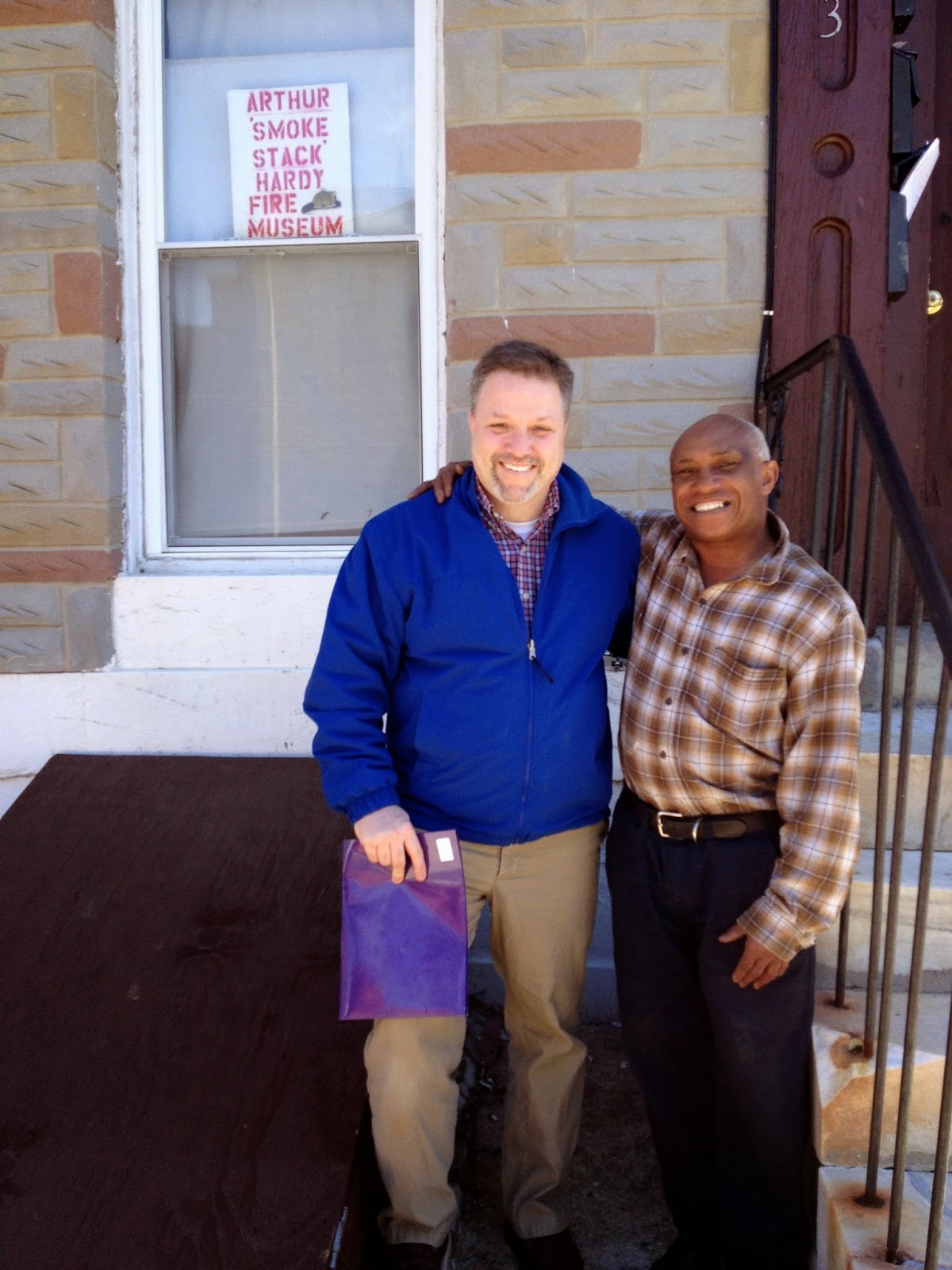
Next, I went to the Smokestack Hardy Folk Museum.  Arthur P. Hardy, also known as Smokestack Hardy, was one of the first African Americans to be a part of the Baltimore Fire Department.  He and Darnell were close friends.  


The museum is run by Hardy's nephew, Guy Cephas.  


The museum was filled with memorabilia Hardy had collected as well as tons of photographs that Hardy took.  Many of the photographs were on the scene of some of the biggest fires in Baltimore's history.  


Davis, Hardy and fellow fire fighters circa 1950's.


Cephas and I in front of the museum.


My next stop was the fire station that was named after Smokestack.  The station, located in Hardy's old neighborhood.


My last stop in Baltimore was the Maryland Fire Museum.


The Fire Museum had one of these 'running boards' that was used in each fire house to track equipment around the city.
 The tool on the left was a 'bed key.'  I was curious why on earth one of these would be in a fire museum.  I learned that beds in early colonial times were seen as so valuable that they were to be taken apart and passed out of the windows if possible.  

The tool on the right is a 'rattle.'  Early on, young boys would run down the street to alert the volunteers when a fire started in town.  The rattles were spun and 'clacked' with a loud staccato sound.

 I love this early volunteer fire engine.  The color is right.  Is was called 'pumpkin.'  The black metal elements were pulled up and down to create the pressure that pushed the water to the hoses that were used to put out the fire.


These leather buckets were initially kept in homes.  When a fire started, families would scoop water from their cisterns and run them to the steam boilers. 


I had the chance to meet both the director of the museum and the historian.  She was a tremendous help with 'next steps' for me.  I learned about several more organizations that are going to be very helpful for me with my research. 

Research Visit: Chicago Fire Academy


On January 2, 2014, I went on a research visit to The Chicago Fire Academy.
  When I arrived, I was greeted by Fireman Anthony Downing.  He took me on a tour of the museum that is located in the Fire Academy. 


 It walked us through the development of the department from volunteer through the Great Chicago Fire and beyond.  I was there for some background on the events on and around the fire of 1871.  One of my favorite elements of the museum was a replica of a firehouse from around the 1880's.  It was complete with horse stable and living quarters above.  


 I could imagine this device being critical to getting crews into the right place amidst the crackle of a house fire. 


I learned that early on, most families had these buckets and would bring them to help fire fighters fill boiler.


A typical fighting force.  Steam boiler in the back with the 'crew' in the front in a separate wagon.


 The first African-American fire house in Chicago was created in 1872.


I had no idea when I called ahead to arrange my visit that I would have Anthony as my tour guide.  Anthony took me through the entire academy.  I viewed the equipment, facilities and classrooms.  It wasn't until we sat down at his desk and started talking about writing.  It turns out that Anthony is also a writer.  We talked about how he uses writing to help make sense of some of the very scary and sad things he sees in his work.  Very recently, Anthony lost one of his best friends in a fire.  


 In the Hall of Honor, sit the equipment of fallen fire fighters.  The most recent was Corey Ankum.  Anthony shared the story of the day he was lost.  Then, he pulled out his phone and shared with me the poignant and powerful words he wrote to make sense of the feelings and overwhelming emotions he was experiencing.  Anthony told me that he has been writing since he entered the academy; I was amazed that he did all of his writing on his phone.


The badge and plaque for firefighter Ankum.  


After spending the better portion of an afternoon with Anthony, I had even more respect for the men and women who put their lives on the line to fight fires.  Anthony and his co-workers were thrilled to hear that I was writing about the department.  They wished me luck and asked to be kept in the loop as my projects developed.  They connected me with the department historian and offered ongoing insight and support.  I hope sometime soon I'll be able to share a published project with them!


The bronze flame in front of the Chicago Fire Academy sits in the exact spot where the Great Chicago Fire of 1871 began.

Friday, August 8, 2014

Research Visit: Flying on the Wright B. Flyer


Sometimes you don't realize you are doing research.  Sometimes you just think you are doing something you've always dreamed about.

On August 26, 2000, I had the chance to fly on the Wright B. Flyer. My parents, as a birthday gift, had given me a membership to the Wright B. Flyer Historical Society. One of the benefits of this was an 'orientation flight' on the 'B.'  I wish the technology that exists today was there on that day so that I could have recorded my flight.  This video captures much of what I remember:  


 The tiny airport has a hangar museum dedicated to the Wright's.  It chronicled the process of building the Wright B. Flyer replica.

I love this image my wife captured.  I talk when I'm nervous.  I didn't stop talking for most of the flight.  The pilot told me when we landed that he hadn't had a passenger who knew more about the Wrights.  I think that was a compliment!


I couldn't have been more proud than I was that day.  As the pilot handed me my certificate, I felt a kinship with all the men and women who have taken to the skies.


I plan to fly again on the Wright B.  This time I'll have my Go Pro mounted to the wing!