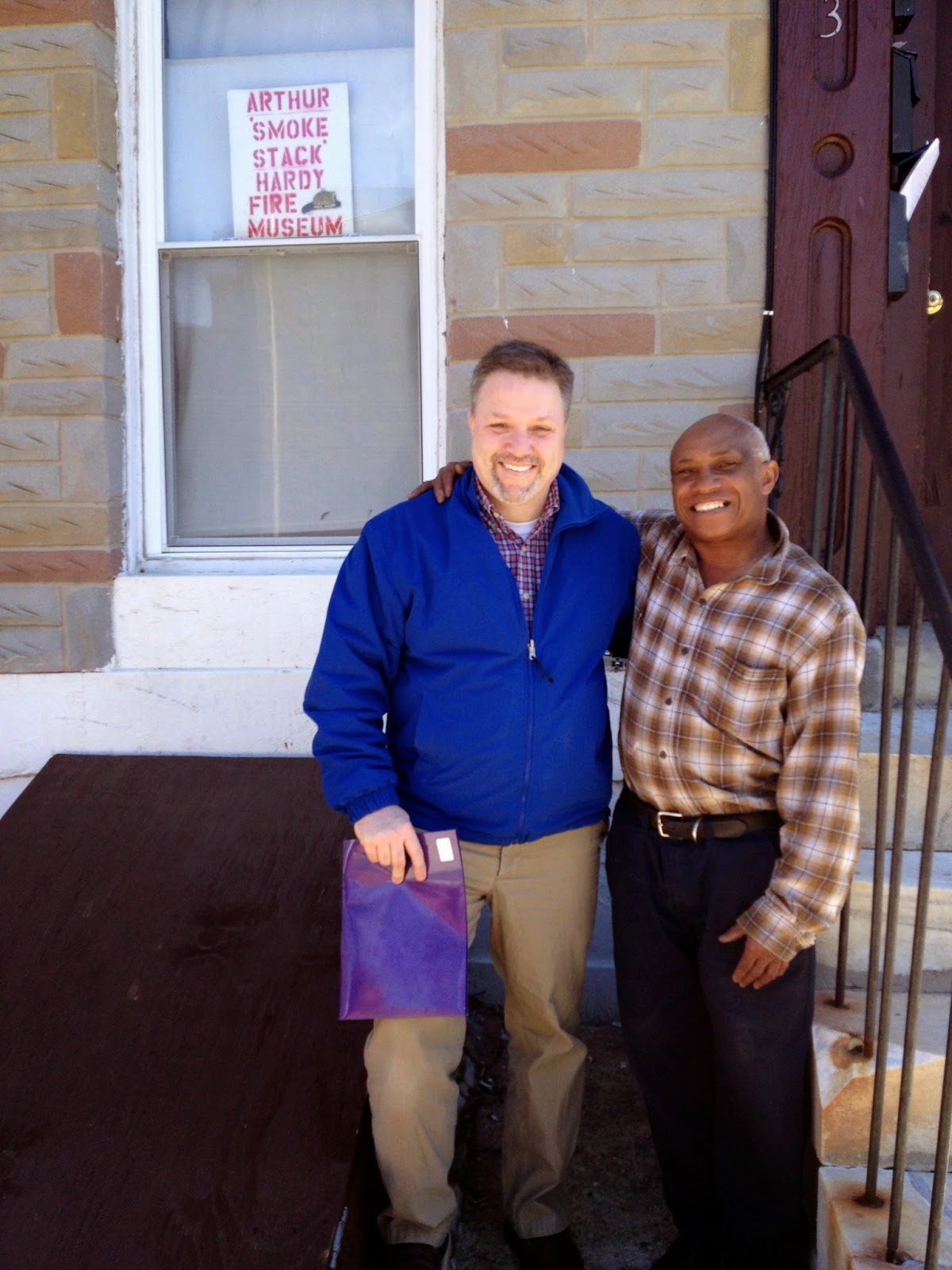
Over Spring Break this year I decided to take a road trip to Baltimore. I am working on a couple of stories that center on the area and I was looking forward to actually meeting many of the people I had been corresponding with as part of this work.
First I met with Darnell Davis, a 98 year-old former fire fighter in Baltimore. He was as sharp as a tack an could not have been more proud of his service. He shared his life with me and I could have spent all day with him.
Next, I went to the Smokestack Hardy Folk Museum. Arthur P. Hardy, also known as Smokestack Hardy, was one of the first African Americans to be a part of the Baltimore Fire Department. He and Darnell were close friends.
The museum is run by Hardy's nephew, Guy Cephas.
The museum was filled with memorabilia Hardy had collected as well as tons of photographs that Hardy took. Many of the photographs were on the scene of some of the biggest fires in Baltimore's history.
Davis, Hardy and fellow fire fighters circa 1950's.
Cephas and I in front of the museum.
My next stop was the fire station that was named after Smokestack. The station, located in Hardy's old neighborhood.
My last stop in Baltimore was the Maryland Fire Museum.
The Fire Museum had one of these 'running boards' that was used in each fire house to track equipment around the city.
The tool on the left was a 'bed key.' I was curious why on earth one of these would be in a fire museum. I learned that beds in early colonial times were seen as so valuable that they were to be taken apart and passed out of the windows if possible.
The tool on the right is a 'rattle.' Early on, young boys would run down the street to alert the volunteers when a fire started in town. The rattles were spun and 'clacked' with a loud staccato sound.
I love this early volunteer fire engine. The color is right. Is was called 'pumpkin.' The black metal elements were pulled up and down to create the pressure that pushed the water to the hoses that were used to put out the fire.
These leather buckets were initially kept in homes. When a fire started, families would scoop water from their cisterns and run them to the steam boilers.
I had the chance to meet both the director of the museum and the historian. She was a tremendous help with 'next steps' for me. I learned about several more organizations that are going to be very helpful for me with my research.
On January 2, 2014, I went on a research visit to The Chicago Fire Academy.
When I arrived, I was greeted by Fireman Anthony Downing. He took me on a tour of the museum that is located in the Fire Academy.
It walked us through the development of the department
from volunteer through the Great Chicago Fire and beyond. I was there
for some background on the events on and around the fire of 1871. One
of my favorite elements of the museum was a replica of a firehouse from around the 1880's. It was complete with horse stable and living quarters above.
I could imagine this device being critical to getting crews into the right place amidst the crackle of a house fire.
I learned that early on, most families had these buckets and would bring them to help fire fighters fill boiler.
A typical fighting force. Steam boiler in the back with the 'crew' in the front in a separate wagon.
The first African-American fire house in Chicago was created in 1872.
I had no idea when I called ahead to arrange my visit that I would have Anthony as my tour guide. Anthony took me through the entire academy. I viewed the
equipment, facilities and classrooms. It wasn't until we sat down at
his desk and started talking about writing. It turns out that Anthony is also a writer. We talked about how he uses writing to help make sense of some of the very scary and sad things he sees in his work. Very recently, Anthony lost one of his best friends in a fire.
In the Hall of Honor, sit the equipment of fallen fire fighters. The most recent was Corey Ankum. Anthony shared the story of the day he was lost. Then, he pulled out his phone and shared with me the poignant and powerful words he wrote to make sense of the feelings and overwhelming emotions he was experiencing. Anthony told me that he has been writing since he entered the academy; I was amazed that he did all of his writing on his phone.
The badge and plaque for firefighter Ankum.
After spending the better portion of an afternoon with Anthony, I had even more respect for the men and women who put their lives on the line to fight fires. Anthony and his co-workers were thrilled to hear that I was writing about the department. They wished me luck and asked to be kept in the loop as my projects developed. They connected me with the department historian and offered ongoing insight and support. I hope sometime soon I'll be able to share a published project with them!
The bronze flame in front of the Chicago Fire Academy sits in the exact spot where the Great Chicago Fire of 1871 began.